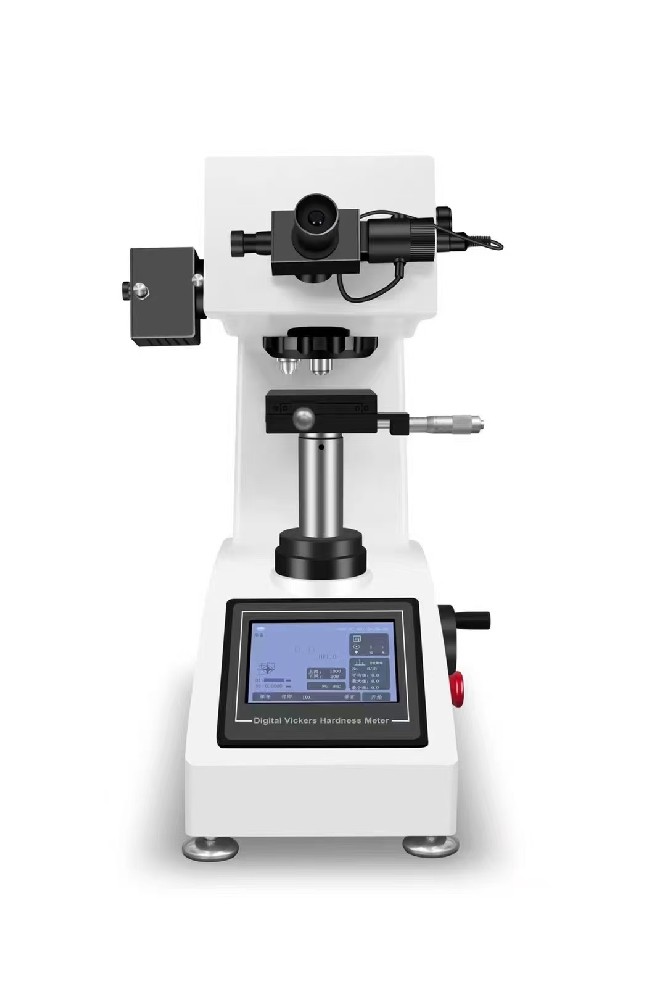
Analysis of the advantages of Vickers hardness tester
Read:1
The Vickers hardness tester, as a high-precision hardness testing instrument, occupies an important position in the field of material testing due to its unique design and testing principle. It exhibits significant advantages, especially in the hardness testing of micro-parts, thin materials, and high-hardness materials.
1. It can adapt to a wide range of materials and hardnesses, with an extremely broad range of applications
The Vickers hardness tester utilizes a diamond indenter in the shape of a regular square pyramid. By applying different test forces (ranging from a few grams to tens of kilograms), it can accurately measure the hardness of almost all metallic materials, whether they are soft aluminum alloys, copper alloys, hardened steel, cemented carbides, or even brittle materials such as ceramics and glass. In comparison, the Rockwell hardness tester is suitable for materials within a specific hardness range, while the Brinell hardness tester is more suitable for softer materials and produces larger indentations. However, the Vickers hardness tester has few such limitations and can meet diverse testing needs.
2. High testing accuracy and good data reproducibility
The detection result of Vickers hardness is obtained by measuring the diagonal length of the indentation and calculating it according to a formula. This method is less affected by human factors. At the same time, the indenter shape of the Vickers hardness tester is regular, and the indentation contour is clear, which facilitates precise measurement. Therefore, the accuracy of test data is high. Under the same conditions, when measuring the hardness value of the same part multiple times, the deviation is small, and the data repeatability is good, providing reliable data support for material quality control and performance research.
3, there is a variety of measurable sample types, with minimal damage to the samples
The indentation made by a Vickers hardness tester is relatively small, especially under low loads, with the indentation diameter typically ranging from only a few microns to tens of microns. Therefore, it causes minimal damage to the specimen and is suitable for hardness testing of precision parts, thin plates, coatings, and heat-treated surface layers. In addition, for specimens with complex shapes, as long as the plane on which the indentation is made is flat, the Vickers hardness tester can also perform effective measurements, such as hardness testing of gear tooth surfaces, bearing raceways, and other parts.
4. The hardness values are uniform, facilitating comparison under different conditions
One notable characteristic of Vickers hardness is that within a certain range of test force, the Vickers hardness value of a material remains constant, independent of the magnitude of the test force. This means that for the same material, regardless of the test force used for testing, the obtained Vickers hardness value is basically consistent. This facilitates comparative analysis of material hardness across different laboratories and under different test conditions. This advantage is particularly important in the research and development, production, and quality inspection of materials.
5, it can detect the hardness of extremely thin surfaces and micro-regions
For some surface-treated materials, such as nitrided layers, carburized layers, and plated layers, the thickness of their surface layers is often very thin, typically ranging from a few microns to tens of microns. The Vickers hardness tester can produce tiny indentations on these extremely thin surface layers by selecting a relatively small test force, thus accurately measuring the hardness of the surface layer without affecting the base material. This advantage has made the Vickers hardness tester widely used in the field of surface engineering.
Summary: The Vickers hardness tester is the preferred choice for high-precision hardness testing
In summary, the Vickers hardness tester plays an irreplaceable role in numerous fields such as aerospace, automotive manufacturing, electronics industry, and material science, owing to its wide applicability, high testing accuracy, good data repeatability, minimal damage to specimens, and ability to detect hardness in micro-regions. Whether it is for quality inspection of raw materials or performance evaluation of components, the Vickers hardness tester can provide accurate and reliable hardness data, providing strong support for product quality control and technological research and development.